
Your opinion matters – let’s shape the future together
Procedure
Talachse thrives on bringing together a variety of perspectives. We listen, answer questions, and explain every step.
Procedure
The process involves a detailed examination and analysis of the Eitorf urban area and begins with an analysis and assessment of the current spatial and functional situation along the valley axis. Building on this, a vision statement and key development goals are developed through a collaborative process.
These form the basis for a framework plan that defines areas of action, spatial priorities, and concrete development measures. This also involves an in-depth urban planning analysis of jointly selected focus areas. The results are finally consolidated into an overall concept, which serves as the strategic basis for further planning and projects.
Phases of the project
Phase 1 – Analysis and Assessment of the Current Situation
During the analysis and assessment phase of the valley axis, the key aspects for Eitorf’s future development are examined and evaluated. In addition to urban structure, land use, housing, employment, and mobility, these aspects include education, tourism, leisure, and recreation.
Particular emphasis is placed on the analysis and assessment of selected transformation areas that will play a particularly significant role in Eitorf’s future development. The identification of restrictions, existing land-use approaches, and potential development opportunities—both for the entire valley area and for the individual transformation areas—forms the technical foundation for the structural concept.
Overall, the first phase serves as a shared knowledge base for all stakeholders and as a starting point for further technical and political discussions.
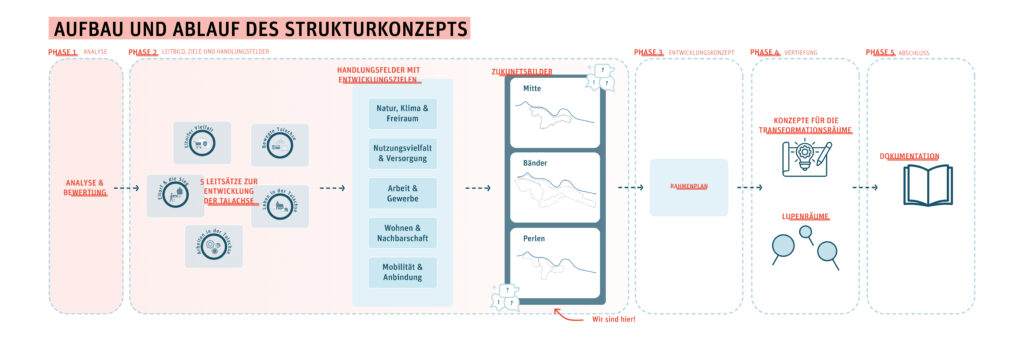
Phase 2 – Mission Statement, Goals, and Development Guidelines
Based on the results of the baseline analysis, the review of existing concepts, and the accompanying public engagement process, a shared vision for the development of the valley corridor is being developed. This includes an overarching, spatially defined vision, strategic development goals, and specific objectives for individual areas of action.
To further shape the plan, various visions of the future will be developed and discussed with citizens, policymakers, and administrative officials. These visions do not dictate a final course of development but rather highlight different possibilities for how the valley axis could evolve in the future. They bring opportunities and challenges to light and help identify shared ideas, aspirations, and goals that will be further refined in the subsequent planning process.
Phase 3 – Development Plan
In the next step, a structural concept for the entire valley axis will be developed based on the identified development opportunities and key objectives. This process will integrate spatial, functional, economic, and transportation aspects. The structural concept outlines the long-term development of the valley axis and highlights potential synergies among future land uses.
To ensure that the urban structural concept functions effectively as an implementation-oriented tool, concrete measures will be defined to provide a clear impetus for the desired development of the valley axis. In Phase 3, feasible, solution-oriented approaches will be formulated based on the goals and fields of action developed in Phase 2. These include catalytic measures as priority key projects, as well as supporting measures to reinforce these initiatives. The jointly developed measures will finally be spatially located within the urban structural concept.
Phase 4 – Proposals, Recommendations, and Implementation Prospects
In the context of spatially significant measures, in-depth urban planning studies serve as a key tool for refining and evaluating development concepts. These studies take the form of so-called “magnifying glass areas,” in which selected sections of the Eitorf valley axis are examined in depth and developed through urban planning test designs. The goal of these in-depth studies is to identify spatial, functional, and design perspectives—particularly for the central transformation areas—and to establish a sound foundation for further planning decisions and implementation steps.
Phase 5 – Conclusion
Phase 5 serves to consolidate and finalize the objectives and measures developed through dialogue in the preceding phases. The agreed-upon results are documented in a final report and supplemented by implementation recommendations that include both a prioritization of the measures and proposals for the timing and organizational implementation of the structural concept.
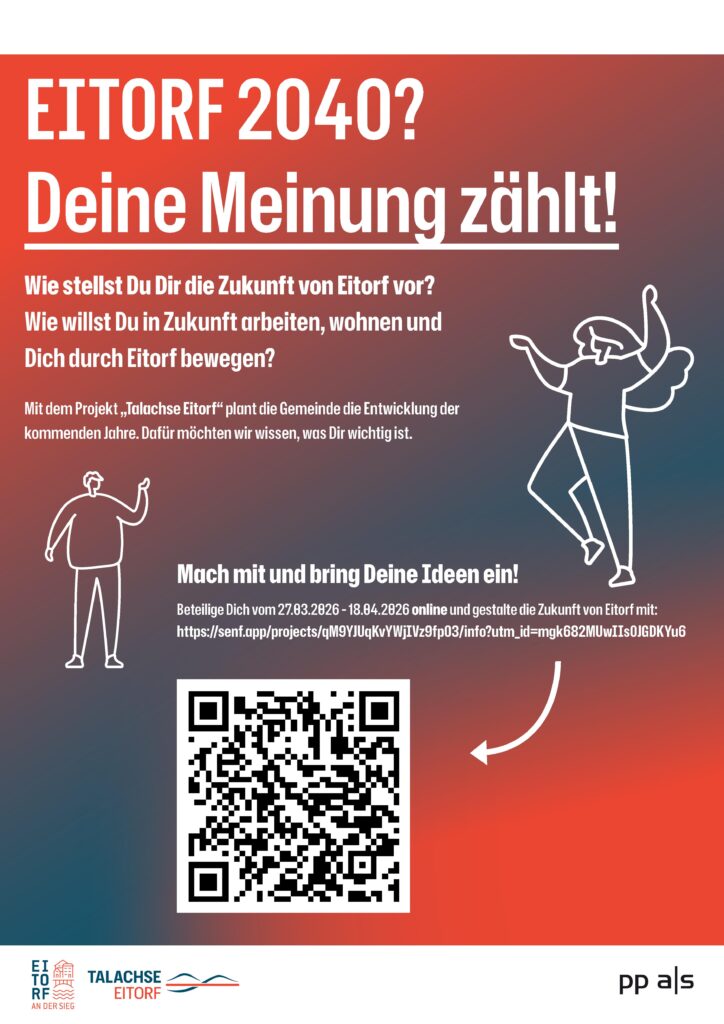
Click here to visit the participation website
Cookie Notice: You are about to leave the Talachse Eitorf website.
Feel free to ask questions at any time
Can't make it to our events? No problem! Use our contact form to ask your questions anytime. We're here to listen and will respond to every inquiry personally.